
Oncology Clinical Applications: 5 of 6
Treatment-Response Monitoring
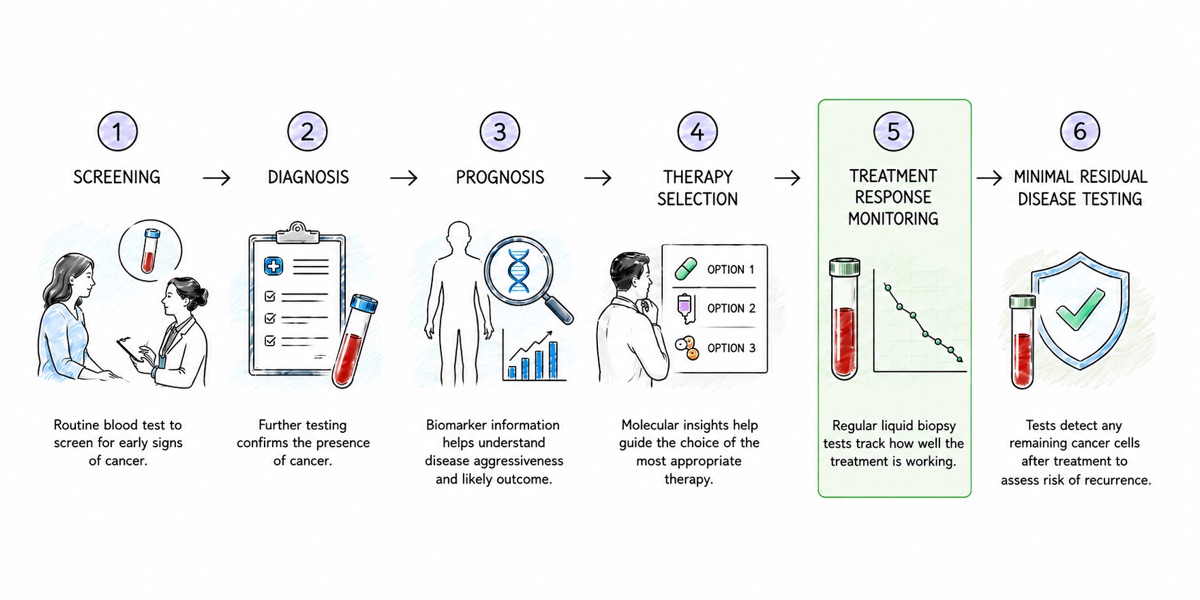
Once cancer treatment starts, everyone wants to know the same thing: is it working? Usually that means taking a scan, waiting several weeks, taking another scan, and comparing the tumor's size.
Scans do not always give a quick answer. A tumor may take time to shrink even when a drug is working. Some treatments stop growth without making the tumor smaller. Others trigger inflammation that makes a tumor look temporarily larger. Scans also require an appointment and specialized equipment, and some expose the patient to radiation, so they cannot be done every few days.
Tumor DNA in the blood changes on a much shorter timescale. It lasts in the bloodstream for only hours, so its level can reflect what is happening now. If treatment is killing cancer cells, the amount may fall sharply within days. If the cancer starts growing again, it may rise. Repeated blood draws can turn those measurements into a trend rather than a couple of isolated snapshots. Blood also collects DNA from cancer deposits throughout the body, whereas a scan may focus on particular sites.
Interpreting the trend takes care. Tumor DNA can move for reasons other than treatment success or failure. A burst of cancer cell death can temporarily raise the level. Surgery, inflammation, and other illnesses can change the total amount of cell-free DNA in blood, which changes the proportion coming from the tumor. One reading by itself can be misleading.
There is also a harder clinical question. Suppose the tumor DNA level has not fallen two weeks into treatment. Should the doctor switch therapies immediately, or wait for the planned scan? An earlier signal only helps if acting on it improves the patient's outcome. The replacement treatment has its own risks, and the blood result is not perfect. Trials are needed to show when an early change in the blood should actually change the treatment plan.
In this index: 9,766 of the classified papers and patents concern monitoring response during treatment.
This page explains what these tests are and how researchers use them. It is not medical advice, and it is not a guide to whether any test is right for you or for a patient. Talk to a clinician about testing decisions.