
Oncology Clinical Applications: 3 of 6
Prognosis
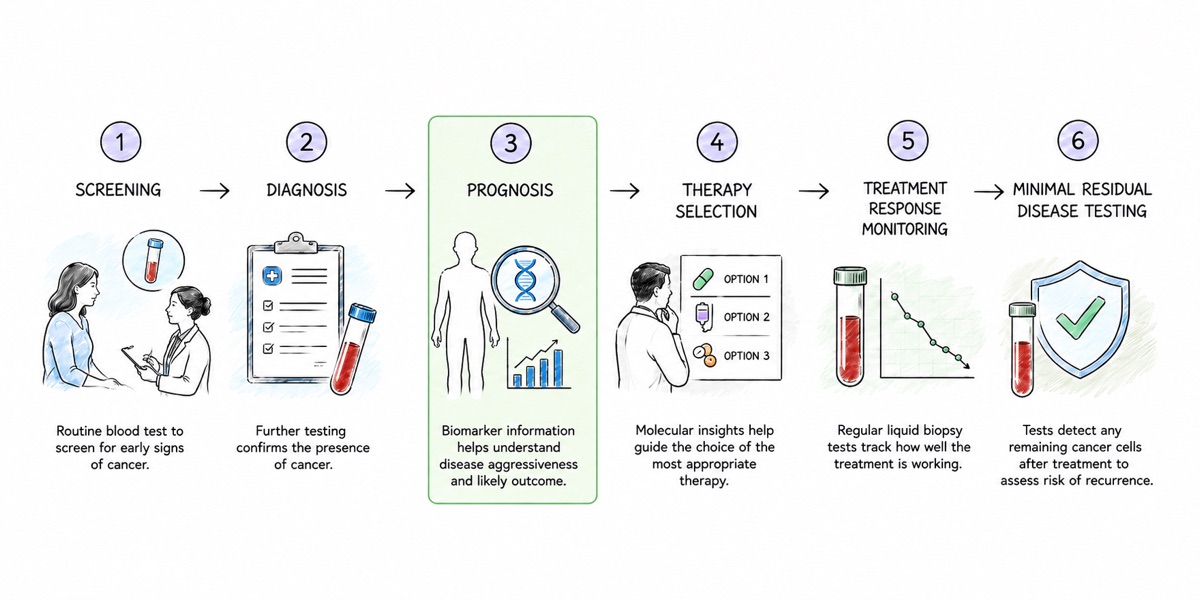
Prognosis is an estimate of how a disease is likely to behave over time. Two people can have cancers with the same name and the same stage yet have very different outcomes. The usual labels tell part of the story, but they do not capture every difference between the tumors.
Doctors already estimate prognosis from things such as tumor size, spread to lymph nodes or other organs, how abnormal the cells look under a microscope, and the person's general health. Those measures are useful, but people within the same category can still have a wide range of outcomes.
Blood measurements are being used to make those estimates more precise. A prognostic measurement is taken around the time of diagnosis, before treatment or very early in it, and is used to predict what is likely to happen. That is different from checking whether a treatment is working or looking for disease left behind after treatment.
Several kinds of blood signal can be used this way. The amount of tumor DNA circulating before treatment often reflects how much cancer is present, including disease too small to see on a scan. The number of whole cancer cells found in blood can carry similar information. Some genetic faults are linked with more aggressive behavior, and patterns across many circulating proteins have also been studied as prognostic markers.
The practical reason to care about prognosis is treatment intensity. Cancer treatment can cause real harm as well as benefit, so doctors try to match it to the person's risk. Someone with a high chance of recurrence may be offered additional treatment after surgery. Someone at low risk may be able to avoid it and avoid the side effects. A blood measurement is useful when it separates those groups more accurately than the tools already available.
There is an important limit. Prognostic markers describe probabilities across groups of people. They do not tell the future for one individual. Some people labeled high risk will do well, and some labeled low risk will not. A marker can shift the odds without settling the outcome. Plenty of studies find statistically real differences between groups that are still too small to change a treatment decision.
In this index: 11,303 of the classified papers and patents concern prognosis.
This page explains what these tests are and how researchers use them. It is not medical advice, and it is not a guide to whether any test is right for you or for a patient. Talk to a clinician about testing decisions.