
Analytes: 6 of 6
Metabolites
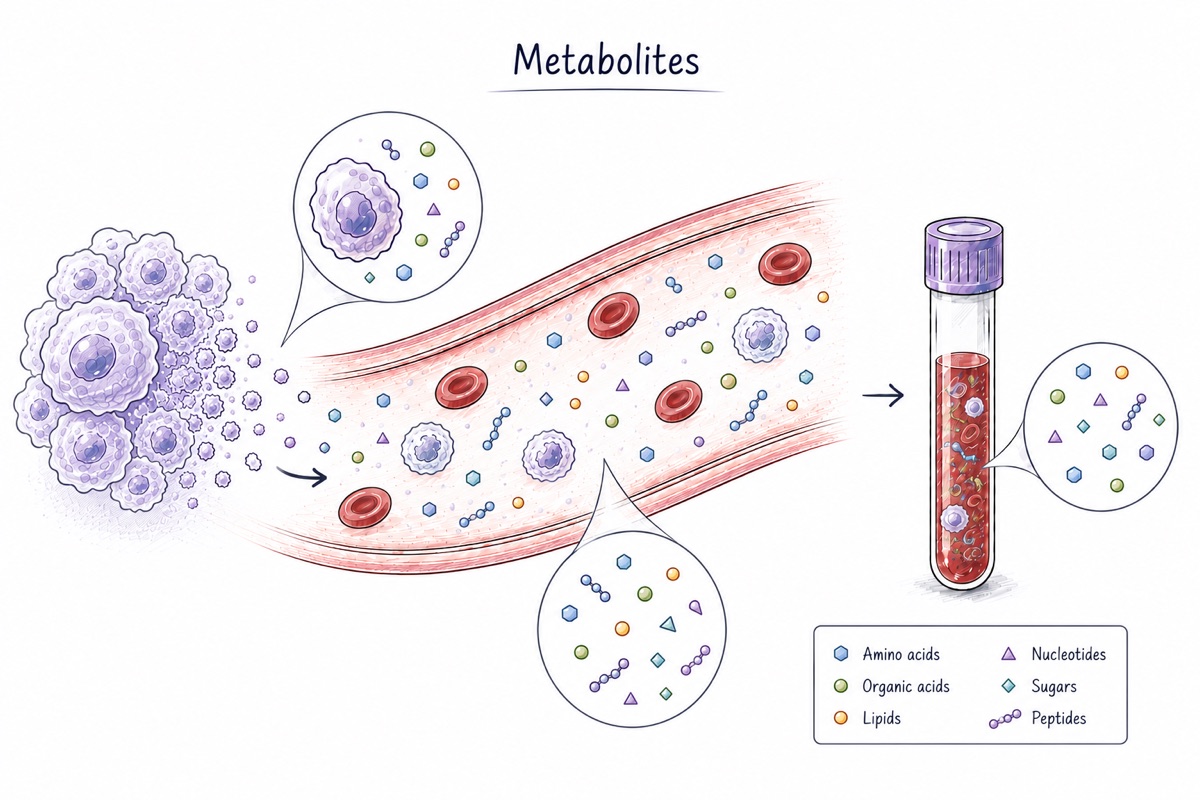
Metabolites are the small molecules involved in the body's chemical reactions. They include sugars, fats, amino acids, and many of the products created as the body builds things up or breaks them down.
You can think of them as sitting near the end of a chain. DNA stores instructions, RNA carries working copies of those instructions, and proteins carry out much of the work. Metabolites are produced and used as that work happens. Because of that, they can give a close-up view of what is going on in the body around the time a sample is taken.
That immediacy also makes them noisy. What someone ate, how much they slept, what medications they take, how much they exercised, and even the bacteria in their gut can shift metabolite levels. Sometimes those everyday effects are larger than the change caused by disease. Studies therefore have to be careful about when and how samples are collected, or the results can be hard to interpret.
The measurements themselves are also challenging. Unlike DNA, which is built from a small set of repeating units, metabolites include thousands of chemically unrelated compounds. A machine may detect a signal without researchers being able to say exactly which molecule produced it. Many signals reported in published studies still have not been identified.
This remains the smallest of the six analyte categories in this index by a wide margin. That reflects both the technical difficulty and the fact that large-scale metabolite measurement became practical later than some of the other approaches.
In this index: metabolites appear in 1,467 of the classified papers and patents, the smallest of the six categories.
This page explains what these tests are and how researchers use them. It is not medical advice, and it is not a guide to whether any test is right for you or for a patient. Talk to a clinician about testing decisions.