Analytes: 1 of 6
Cell-Free DNA (cfDNA) And Circulating Tumor DNA (ctDNA)
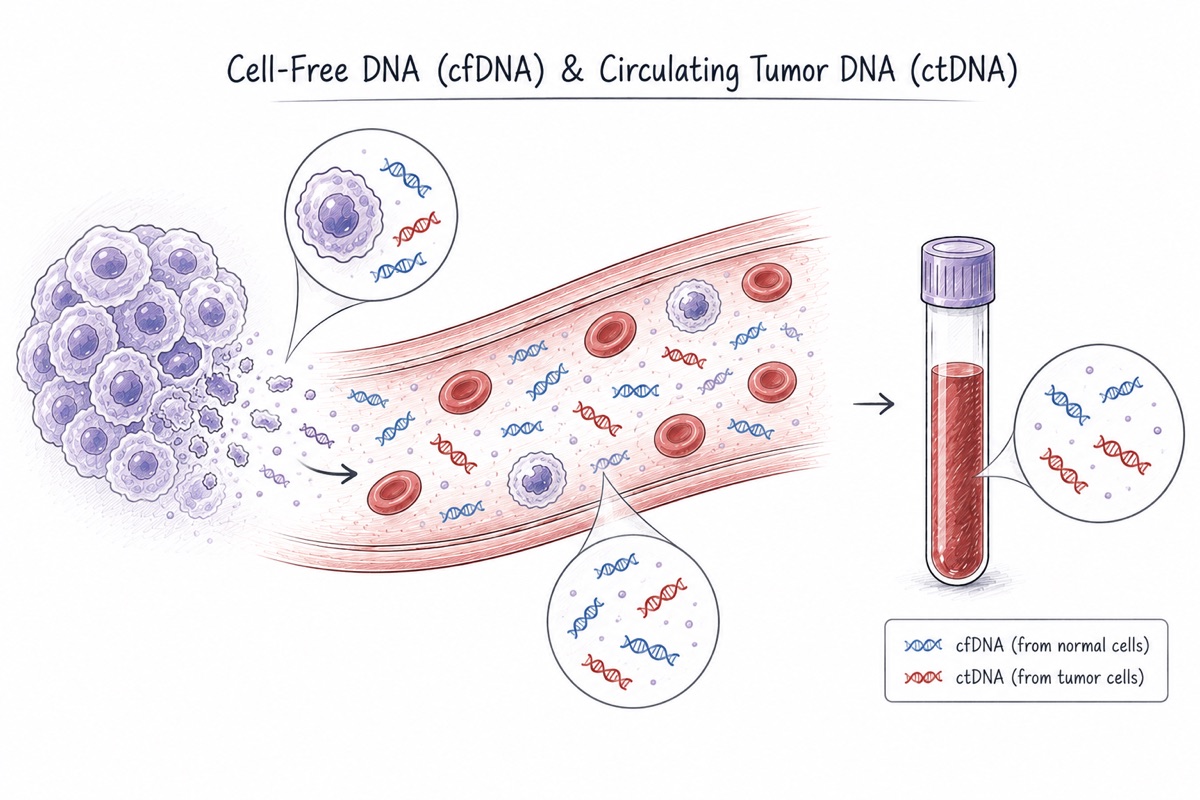
If you spin a tube of blood in a machine, the red and white blood cells settle to the bottom and a pale yellow liquid remains on top. That liquid is plasma. Floating in it are small pieces of DNA that are no longer inside a cell. These pieces are called cell-free DNA, or cfDNA. They are there because cells throughout the body are constantly dying and releasing their contents into the bloodstream. That is normal and happens in everyone.
The DNA fragments are not broken into completely random pieces. Inside a cell, DNA is wrapped around proteins, a bit like thread around a spool. The wrapped sections are partly protected while exposed sections are broken down. As a result, the fragments that survive in blood carry some information about where they came from, because different tissues package their DNA in slightly different ways.
In someone with cancer, some cfDNA may come from tumor cells. That portion is called circulating tumor DNA, or ctDNA. It can carry the same genetic faults as the tumor itself, which is why a blood sample can sometimes answer questions that would otherwise require a tissue biopsy. Instead of removing part of a tumor with a needle or during surgery, a laboratory may be able to read those faults from ctDNA in the blood.
The hard part is that there is often very little ctDNA to find. Larger and more advanced tumors generally release more of it, while small cancers that have not spread may release only tiny amounts. That makes ctDNA much harder to use for a test for people who feel perfectly well. It also disappears from the bloodstream quickly, usually within hours. That short lifetime makes it useful for watching whether a treatment is working, because the amount in blood can change fairly quickly as the cancer changes.
Much of the research over the past decade has focused on simply finding and measuring ctDNA reliably when it is present at very low levels.
cfDNA is useful outside cancer too. The same principle works whenever DNA in the bloodstream comes from a source that can be distinguished from the person's own DNA. During pregnancy, some DNA in the mother's blood comes from the pregnancy and forms the basis of routine prenatal screening in many countries. After an organ transplant, some circulating DNA comes from the donated organ, and an increase can be an early sign that the organ is being injured or rejected.
In this index: cfDNA and ctDNA are the most studied of the six blood components tracked here, appearing in 28,752 of the classified papers and patents.
This page explains what these tests are and how researchers use them. It is not medical advice, and it is not a guide to whether any test is right for you or for a patient. Talk to a clinician about testing decisions.