
Oncology Clinical Applications: 1 of 6
Screening
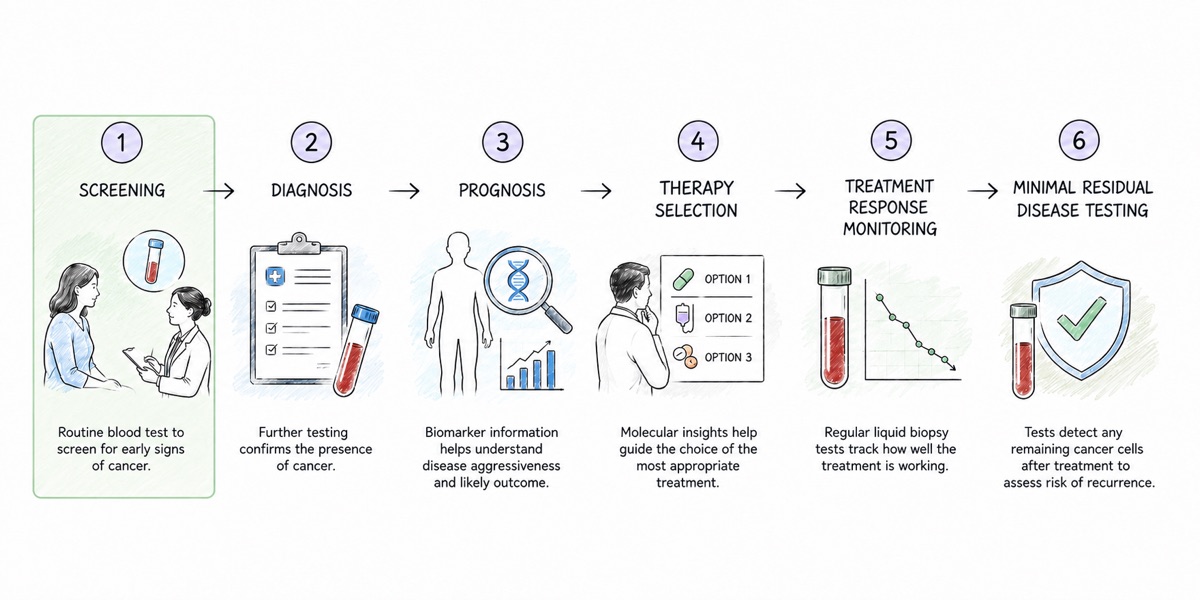
Screening means testing people who feel well to look for disease before it causes symptoms. Diagnosis starts later, once there is already something to explain, such as a symptom or an abnormal result. Screening begins with a group of apparently healthy people and asks whether any of them may be carrying a disease they do not know about.
Most cancer screening today is built around imaging or physical procedures. Mammograms use low-dose radiation to look at breast tissue. Colonoscopies use a camera to examine the bowel. These methods save lives when they are used widely, but each one focuses on a particular part of the body and requires its own equipment and trained staff. Some are unpleasant enough that many people who are invited to be screened never go.
Blood-based screening starts from the fact that even a small tumor can shed material into the bloodstream. A blood test might therefore pick up a cancer without knowing in advance where it is. Some tests look for one cancer at a time. Others search a single blood sample for signs of many cancers, an approach often called multi-cancer early detection. If a test finds a possible cancer, it also needs to give some clue about where in the body it came from. Otherwise the doctor is left searching everywhere. One way to do that is to read chemical marks on DNA fragments that differ between tissues.
The arithmetic is unforgiving. Cancer is rare in any one year among people who have no symptoms. Imagine a test that is correct 99 times out of 100 when it says someone is clear. That sounds excellent, but if only a few people in every thousand actually have cancer, many of the positive results can still be false alarms. Those false alarms may lead to scans, worry, and sometimes invasive procedures in people who were healthy to begin with. Screening tests therefore need especially strong evidence before they are used broadly.
There is another problem: early cancers are often the hardest ones to detect. A small tumor that has not spread usually releases very little material into the blood. A large, advanced tumor releases much more.
For ctDNA, the difference can be dramatic. Almost all of the loose DNA in blood comes from normal cells that are constantly dying. In an early cancer, tumor DNA may be on the order of one fragment in ten thousand. By the time a cancer is advanced, there may be closer to a thousand tumor fragments in the same amount of background DNA. The test did not suddenly become smarter. There was simply more cancer signal to find.
That creates an awkward bias. Blood tests tend to find the cancers that are already easier to find, while the smallest cancers, where early detection might matter most, are the easiest to miss. Multi-cancer tests face this problem especially strongly, and a positive result in someone who feels completely well can begin a search for something that is tiny or may not be there at all.
None of this means blood-based screening cannot work. It does mean that finding cancer is only part of the question. The more important test is whether screening actually helps people live longer, which takes more evidence to show.
In this index: 9,346 of the classified papers and patents concern screening, whether for one named cancer or for many at once.
This page explains what these tests are and how researchers use them. It is not medical advice, and it is not a guide to whether any test is right for you or for a patient. Talk to a clinician about testing decisions.