
Oncology Clinical Applications: 4 of 6
Therapy Selection
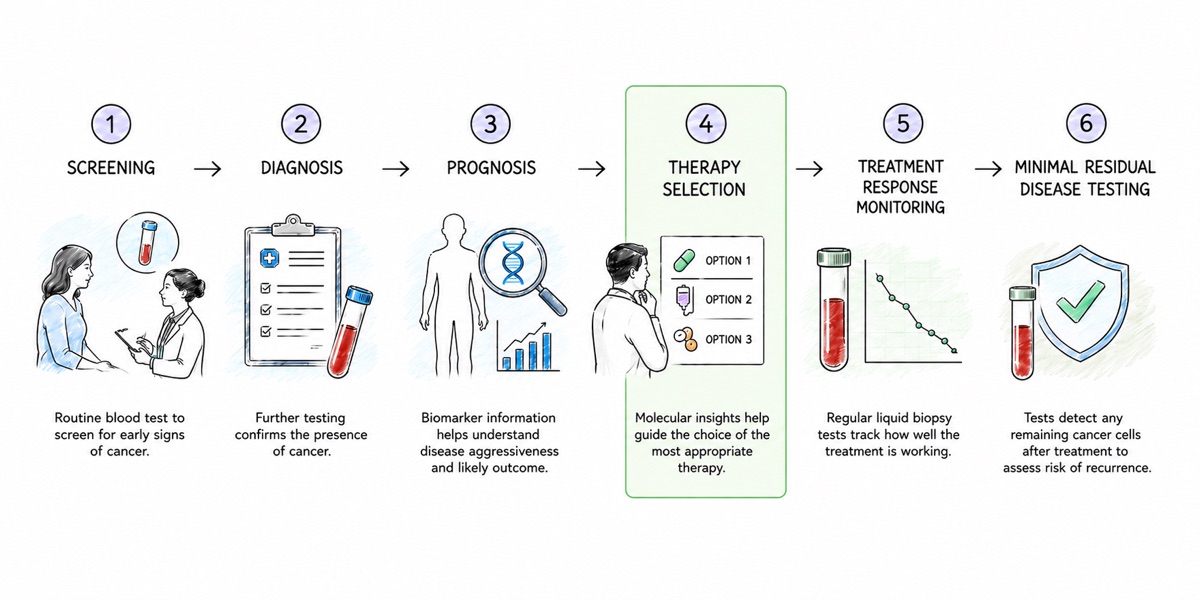
Some cancer drugs are designed to target a specific fault inside a cancer cell. They can work very well when the tumor carries that fault and do little when it does not. Before prescribing one of these drugs, a doctor needs to know what is actually driving that person's tumor.
The usual way to find out is to remove a piece of the tumor with a needle or during surgery and analyze its genetic instructions in a laboratory. Tissue testing works well and remains the reference method. It can also be hard to do. A tumor may be deep in the lung or close to a major blood vessel. A patient may be too unwell for another procedure. Sometimes the sample is simply too small. And one piece of one tumor does not always represent every cancer deposit elsewhere in the body.
Tumor DNA circulating in the bloodstream can carry the same faults as the tumor that released it, so a blood draw can sometimes answer the same treatment question. Blood also collects material from multiple cancer deposits, which means it may reveal a fault that was missed in the original tissue sample. Results can often come back faster too, which matters when treatment cannot wait.
When a test is specifically used to decide whether someone should receive a particular drug, it is called a companion diagnostic. It is tied to that drug rather than being used as a general investigation.
Positive and negative blood results do not carry the same weight. If the test finds a relevant fault, that finding can usually be acted on. If it finds nothing, the tumor may truly lack the fault, or there may simply have been too little tumor DNA in the blood to detect it. Small or slow-growing tumors often shed very little. For that reason, a negative blood test may send the doctor back to tissue rather than close the question.
Blood also has an advantage later on because it is easy to repeat. Cancers can change under treatment, and a tumor that once responded may develop a new fault that makes the drug stop working. Another blood sample can sometimes show what changed without requiring another tissue biopsy.
In this index: 6,901 of the classified papers and patents concern blood-based therapy selection.
This page explains what these tests are and how researchers use them. It is not medical advice, and it is not a guide to whether any test is right for you or for a patient. Talk to a clinician about testing decisions.