
Oncology Clinical Applications: 6 of 6
Minimal Residual Disease (MRD)
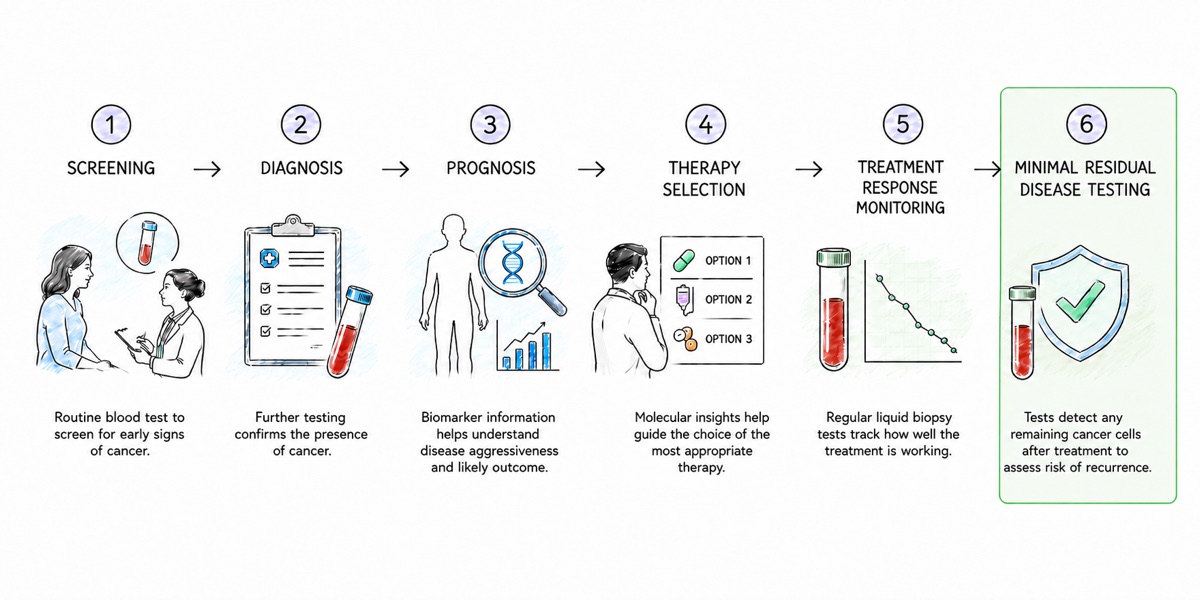
After surgery removes a tumor, or after a course of treatment intended to cure the cancer, scans may show nothing left. That is encouraging, but scans can only see disease above a certain size. A small number of cancer cells can remain somewhere in the body without appearing on an image. If those cells later grow, the cancer comes back. Minimal residual disease, or MRD, is the term for that leftover disease that is present but too small to see with standard imaging.
A blood test can sometimes pick it up because the surviving cancer cells still shed DNA into the bloodstream. Finding tumor DNA when scans are clear is evidence that cancer remains. Not finding it is reassuring, but it does not prove that every cancer cell is gone.
One approach starts with the removed tumor. A laboratory identifies genetic faults that are specific to that person's cancer and then searches the blood for those exact changes. Knowing what to look for can make the test very sensitive, but the process requires tumor tissue and time to prepare the personalized test. Another approach looks directly in blood for broader signs of cancer without building a custom list first. That can start sooner and can work when tumor tissue is unavailable, though it may miss more disease.
The appeal of MRD testing is the lead time. Tumor DNA can sometimes appear in blood months before a recurrence becomes visible on a scan, and in some cancers that gap can approach a year.
How useful that warning is depends on what happens next. A negative result means the test did not find disease, not that disease is definitely absent. Some cancers shed very little DNA even when they are present, so the same result can mean different things in different tumor types. A positive result also raises a treatment question: does starting therapy months earlier actually improve the outcome? That has to be tested for each setting rather than assumed. Much of the current work in MRD is aimed at answering exactly that.
In this index: 4,379 of the classified papers and patents concern minimal residual disease.
This page explains what these tests are and how researchers use them. It is not medical advice, and it is not a guide to whether any test is right for you or for a patient. Talk to a clinician about testing decisions.