
Oncology Clinical Applications: 2 of 6
Diagnosis
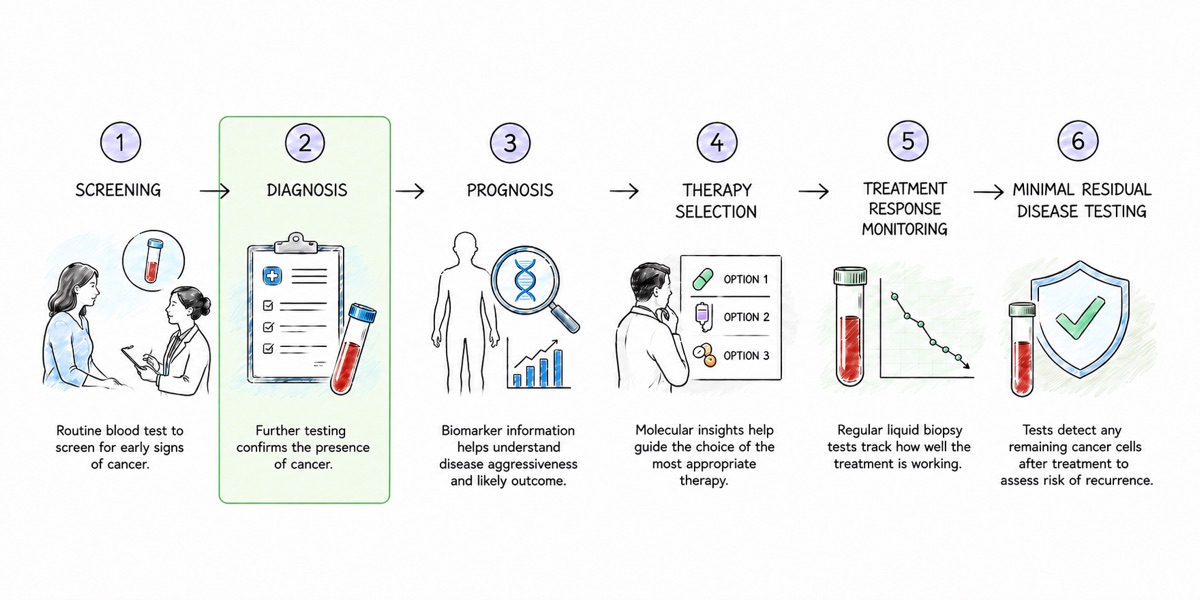
Screening asks whether a person who feels well might have a hidden cancer. Diagnosis begins once there is already something to explain, such as a shadow on a scan, a lump, an abnormal blood result, or a symptom that will not go away. At that point the question is more specific: what is this finding?
A blood test may help answer several parts of that question. One is whether a suspicious finding is cancer at all, and many are not: a lung nodule, a pancreatic mass, or an ovarian cyst can be harmless, and telling those apart from cancer without an operation is a long-standing problem. If it is cancer, doctors may also need to know what type it is, because two tumors in the same organ can behave differently and need different treatment. Sometimes cancer has already spread but the original organ cannot be found. Knowing where it started matters because treatment usually follows the organ of origin. Blood-based tests may also help with staging, the process of working out how far a cancer has spread.
Different materials in blood can contribute different clues. DNA shed by a tumor carries genetic faults that can distinguish cancer from healthy tissue. It can also carry chemical marks that hint at which tissue released it. Whole cancer cells in the blood can be examined much like cells from a biopsy. Proteins and other molecules can add further evidence.
The same test can behave very differently in diagnosis than it does in screening because the people being tested are different. In a clinic full of patients who already have suspicious findings, cancer is much more common than it is in a healthy population. A positive result is therefore more likely to be a true one, and a test does not have to clear quite the same statistical hurdle to be useful.
Even so, a blood test rarely settles the diagnosis by itself. Examining tissue under a microscope remains the reference method in most settings. A liquid biopsy may change who needs that tissue sample, who can be watched, or how quickly doctors can narrow down a hidden primary tumor. Small lesions are still difficult, though. If a tiny nodule is shedding almost no material into the blood, a negative blood result is much less reassuring than it would be for a larger mass.
In this index: 3,323 of the classified papers and patents concern diagnosis: telling whether a finding is cancer, and what kind.
This page explains what these tests are and how researchers use them. It is not medical advice, and it is not a guide to whether any test is right for you or for a patient. Talk to a clinician about testing decisions.